
Home / Research Publications / TriAxis Matrix™ CCM Q4 2026
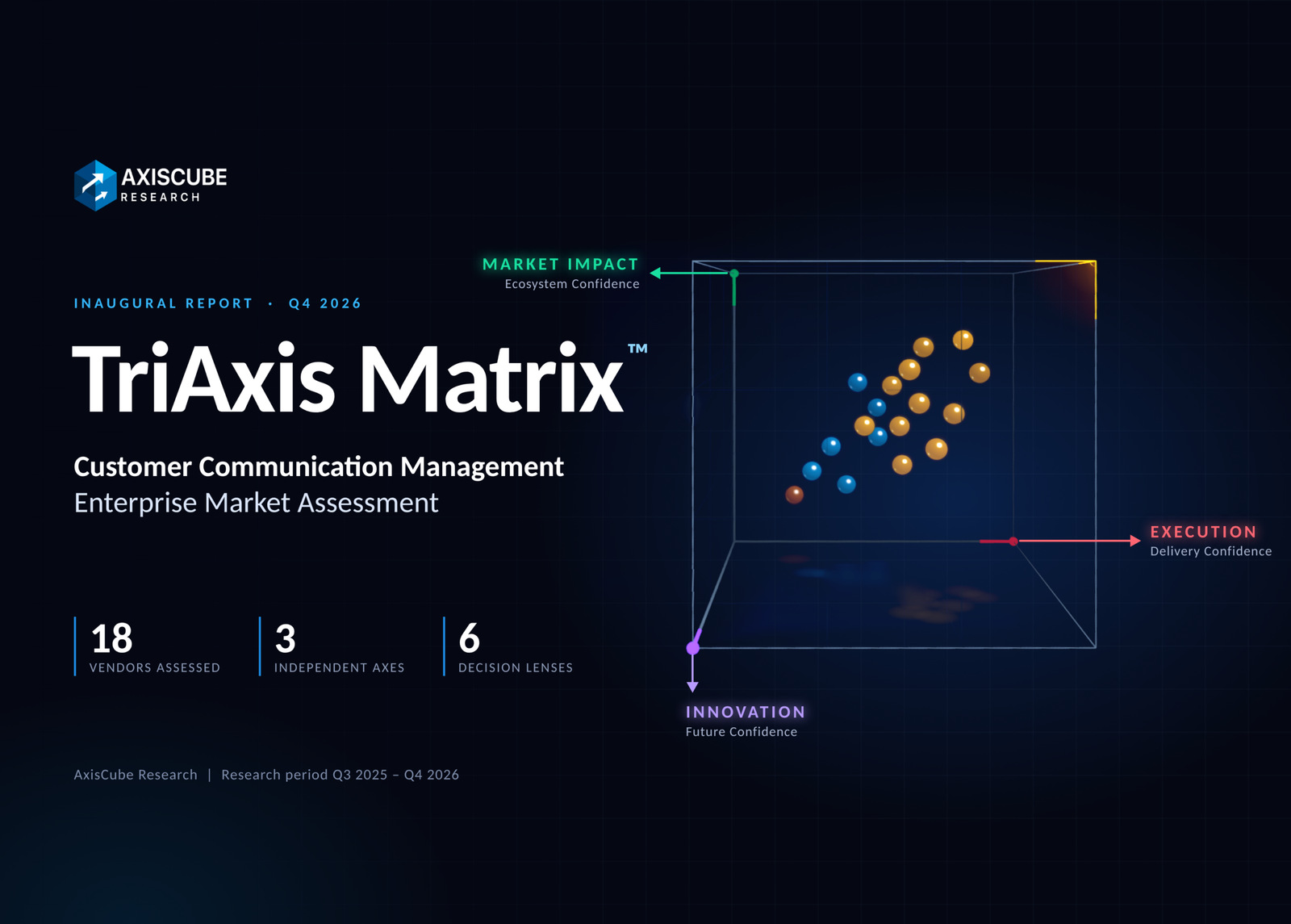
AxisCube Research Publishes TriAxis Matrix™ CCM Q4 2026 Enterprise Market Assessment
New 18-vendor research finds that Customer Communication Management is evolving from document production toward a broader, governed enterprise communication capability
Gurugram, India – October 5, 2026 – AxisCube Research today announced the publication of its TriAxis Matrix™ Customer Communication Management (CCM) Q4 2026 Enterprise Market Assessment, providing an evidence-based assessment of 18 CCM platforms and examining how the market is evolving across enterprise delivery, innovation, ecosystem strength, modernization, AI, governance and communication operations.
The assessment finds that Customer Communication Management is moving beyond its traditional role as a system for producing and distributing high-volume documents. CCM platforms are increasingly connecting communication content with enterprise data, business events, workflows, digital channels, automation and AI, while the foundational requirements of accuracy, consistency, scalability, compliance and controlled production remain critical.
The research period covers Q3 2025 through Q4 2026 and evaluates 18 vendors representing the assessed global CCM vendor set.
A Market Moving Beyond Traditional CCM
According to AxisCube’s analysis, the strategic question for enterprise buyers is increasingly shifting from:
“What features does this CCM platform offer?”
to:
“How effectively does this platform connect communication, data, business processes, governance and delivery within our enterprise environment?”
The assessment identifies six major findings shaping the CCM market:
1. CCM is expanding from document production toward enterprise communication infrastructure.
Communication is increasingly becoming part of broader enterprise processes, connecting content, data, business rules, workflows, governance and multichannel delivery.
2. Legacy modernization and automated quality assurance are becoming strategic platform capabilities.
Vendors are increasingly incorporating capabilities for discovering, rationalizing, reconstructing, migrating and validating complex legacy communication estates.
3. AI differentiation is shifting from feature availability to workflow integration, governance and production maturity.
The research finds that the more meaningful distinction is not whether a CCM platform has AI, but where AI operates within the communication lifecycle and what controls govern its use.
4. Governance, compliance scope and deployment-model specificity are becoming core evaluation criteria.
Enterprise buyers increasingly need to evaluate the actual scope of security, privacy, accessibility, residency, AI and governance controls rather than relying solely on certification labels.
5. The market is differentiating around distinct platform archetypes and buyer priorities.
The assessed vendors demonstrate different strategic emphases across enterprise communications, content governance, document automation, digital engagement, journey orchestration and operational production.
6. Vendor risk is becoming a first-class evaluation dimension alongside product capability.
Ownership and investment changes, architectural lineage and the production maturity of recently introduced capabilities are increasingly relevant to long-term platform decisions.
Introducing a Three-Dimensional View of CCM
The TriAxis Matrix™ evaluates each vendor across three independently scored dimensions:
- Execution – Delivery Confidence: Can the vendor deliver reliably at enterprise scale today, within the buyer’s environment and regulatory constraints?
- Innovation – Future Confidence: Is the platform evolving intelligently enough to remain relevant through the investment lifecycle?
- Market Impact – Ecosystem Confidence: Has the market validated the vendor sufficiently to support an enterprise commitment?
Each axis produces an independent score, with the three scores forming a mathematical three-dimensional coordinate that positions each vendor within the TriAxis environment.
The research emphasizes that the TriAxis Matrix is not a single ranked list. Vendor positioning, leadership archetypes and buyer-specific lenses are intended to provide different perspectives on the same underlying evidence.
Six Decision Lenses for Buyer-Specific Evaluation
Recognizing that enterprises do not all make technology decisions using the same priorities, the assessment also introduces six TriAxis Decision Lenses™:
- Excellence Leader – execution combined with innovation
- Momentum Leader – innovation combined with market impact
- Maturity Leader – execution combined with market impact
- Value Leader – market impact combined with innovation
- Capability Leader – innovation combined with execution
- Impact Leader – market impact combined with execution
The lenses are designed to help buyers interpret the market according to their specific decision priorities rather than relying on a single overall market view.
Evidence-Led Research Methodology
The assessment applies a structured research process beginning with market scoping and vendor inclusion, followed by structured RFI collection, technical briefings and live demonstrations, independent validation, scoring, analyst review and factual verification.
Participating vendors receive a defined factual review period, while scores, coordinates, archetypes and lens designations remain independent analytical outputs rather than subjects of vendor negotiation.
The study evaluates vendors against defined inclusion criteria covering dedicated enterprise CCM capabilities, core CCM use cases, enterprise adoption and active product development.
What the Research Means for Enterprise Buyers
The research concludes that feature breadth is becoming a weaker proxy for CCM platform maturity.
Instead, buyers should evaluate:
- architectural flexibility and enterprise integration;
- modernization and migration capability;
- governed AI use;
- communication lifecycle governance;
- physical and digital channel coordination;
- operational evidence and traceability;
- vendor trajectory and long-term platform viability.
AxisCube recommends that organizations define their business situation and priority communication processes first, establish representative use cases, use the TriAxis landscape to structure the shortlist, apply the Decision Lenses according to their priorities, conduct targeted proofs of concept, and evaluate total cost, risk and exit options before making a final decision.
An Interactive Decision Environment
The digital TriAxis Landscape extends the research beyond a static market chart. Buyers can filter the vendor landscape by leadership archetype, deployment model and region, and compare selected vendors within the same analytical environment.
This allows organizations to move from a broad market view toward a focused, context-specific shortlist while retaining the underlying research framework.
About the TriAxis Matrix™
The TriAxis Matrix™ is AxisCube Research’s three-dimensional, evidence-based framework for evaluating enterprise technology providers.
Rather than treating market leadership as a single-dimensional ranking, the framework examines distinct dimensions of enterprise confidence and enables buyers to interpret vendor positioning according to their own requirements and priorities.
About AxisCube Research
AxisCube Research is an independent research and advisory organization focused on helping technology vendors and enterprises make informed decisions through market intelligence, competitive intelligence and decision frameworks.
Through its research methodologies and platforms, AxisCube seeks to provide a more contextual approach to enterprise technology evaluation—connecting market evidence with the practical decisions organizations need to make.
Explore the CCM Q4 2026 Enterprise Market Assessment:
TriAxis Matrix™ Customer Communication Management (CCM) Q4 2026 Enterprise Market Assessment
Headquarters: Gurugram, India
Website: www.axiscuberesearch.com
Press Contact: contact@axiscuberesearch.com


Book Your Consultation
And Start Growing Today
Connect with our experts and gain tailored insights that accelerate growth, strategy, and market success.